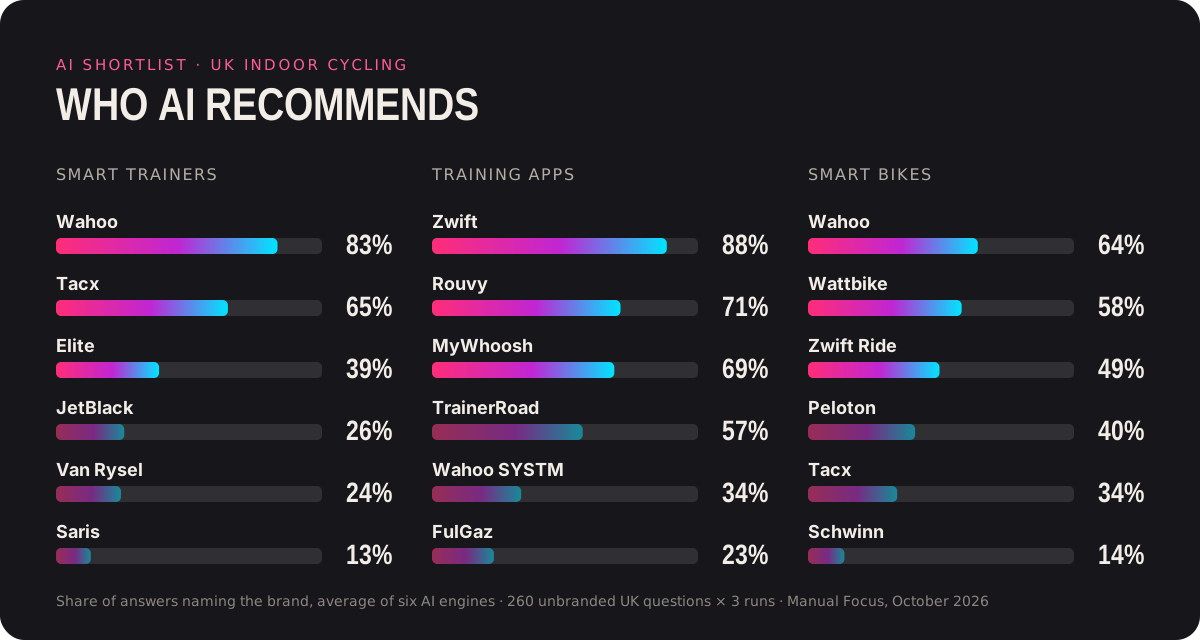
On 19 October 2026 Manual Focus asked six AI engines 309 UK shopping questions about indoor cycling, three times each. Across 5,562 answers, AI named Wahoo in 83% of smart trainer answers, Zwift in 88% of training app answers and Wahoo in 64% of smart bike answers, while cycling media supplied over half the citations.
Brands in the study can request a free one-page AI Shortlist card.
Key takeaways
- Wahoo is AI’s default smart trainer, named in 83% of unbranded trainer answers and placed first by all six engines.
- Zwift leads training apps at 88%, but Rouvy wins scenery questions (97%), MyWhoosh wins value questions (87%) and TrainerRoad leads performance training (84%).
- Smart bikes are close, with Wahoo named in 64% of answers and Wattbike in 58%.
- Challenger brands depend on the engine, as JetBlack ranged from 47% of Claude’s trainer answers to 11% of Google AI Mode’s.
- Editorial sites supplied 51% to 56% of citations, while Reddit, YouTube and forums supplied 3% to 5%.
Why does AI’s answer matter now?
More shopping journeys now start with an AI answer at the top of the results page. Sundar Pichai said at Google I/O on 19 May 2026 that AI Overviews has over 2.5 billion monthly users and AI Mode has passed one billion. In the UK, Ofcom found that about 30% of searches show an AI Overview, and ChatGPT’s UK visits rose from 368 million to 1.8 billion in the first eight months of 2025.
| Signal | Figure | Source |
|---|---|---|
| AI Overviews monthly users | Over 2.5 billion | Google, May 2026 |
| UK searches showing an AI Overview | About 30% | Ofcom, December 2025 |
| UK adults who see AI Overviews often | 53% | Ofcom, December 2025 |
| Clicks on a result when an AI summary shows | 8%, against 15% without | Pew Research Center, July 2025 |
| Tracked brand searches with an AI Overview | 82% | DemandSphere, September 2026 |
The answer also keeps the click. Pew Research Center found that people clicked a search result in 8% of visits when an AI summary appeared, against 15% without one, and clicked a link inside the summary in only 1%. Google now shows an AI Overview on 82% of the brand searches DemandSphere tracks, and it moved links higher inside its AI answers in October, as we covered in what Google’s new AI Mode links mean for brand websites.
For a shopper, the brands named in that answer are increasingly the shortlist. Our study measured that shortlist for one category, and shopping questions triggered an AI Overview far more often than Ofcom’s all-search average, in 64% of our searches.
What did we measure?
We wrote 309 questions the way UK riders ask them, such as “quietest smart trainer for a flat”. The 260 that name no brand make up every headline number, and each carries a tag for the buying moment behind it, from value and beginner to performance and problem questions.
The six engines were ChatGPT and Gemini as the public sees them, Google AI Overviews, Google AI Mode, Perplexity and Claude with web search, all set to a UK location and collected through DataForSEO. Each question ran three times per engine, because AI answers change between runs. An engine named exactly the same brands across all three runs only 20% of the time, from 13% for ChatGPT to 48% for Perplexity, which matches a SparkToro study from January 2026 advising brands to track how often they appear rather than their position.
So the headline measure is the shortlist rate, the share of answers that name a brand, averaged across the six engines, with a 95% range on every figure.
The AI shortlist by category
| Category | Leader | Second | Third | Notable |
|---|---|---|---|---|
| Smart trainers | Wahoo 83% | Tacx 65% | Elite 39% | JetBlack 26%, Van Rysel 24% |
| Training apps | Zwift 88% | Rouvy 71% | MyWhoosh 69% | TrainerRoad 57% |
| Smart bikes | Wahoo 64% | Wattbike 58% | Zwift Ride 49% | Peloton 40% |
Wahoo’s trainer lead is the clearest result, with a 95% range of 79% to 87%. Rouvy and MyWhoosh are effectively tied for second among apps, and Wahoo’s smart bike lead over Wattbike is narrow.
Who wins which buying moment?
For a brand team, the more useful finding sits below the headline table, because the leader changes with the question behind the search.
| Buying moment | Smart trainers | Training apps | Smart bikes |
|---|---|---|---|
| Value | Wahoo 82%, Van Rysel 52% | Zwift 89%, MyWhoosh 87% | Zwift Ride 59%, Wattbike 54% |
| Beginner | Wahoo 73%, Van Rysel 40% | Zwift 93%, MyWhoosh 86% | Peloton 67%, Wattbike and Zwift Ride 52% |
| Performance | Wahoo 93%, Tacx 89% | TrainerRoad 84%, Zwift 82% | Wahoo 89%, Wattbike 73% |
| Scenery | Not asked | Rouvy 97%, Zwift 91% | Not asked |
A brand that wins performance questions can still be missing from the beginner shortlist. Van Rysel, Decathlon’s own brand, appears in roughly half of value answers for trainers but in 9% of performance answers. Peloton, a fitness brand more than a cycling one, leads the beginner moment for smart bikes. 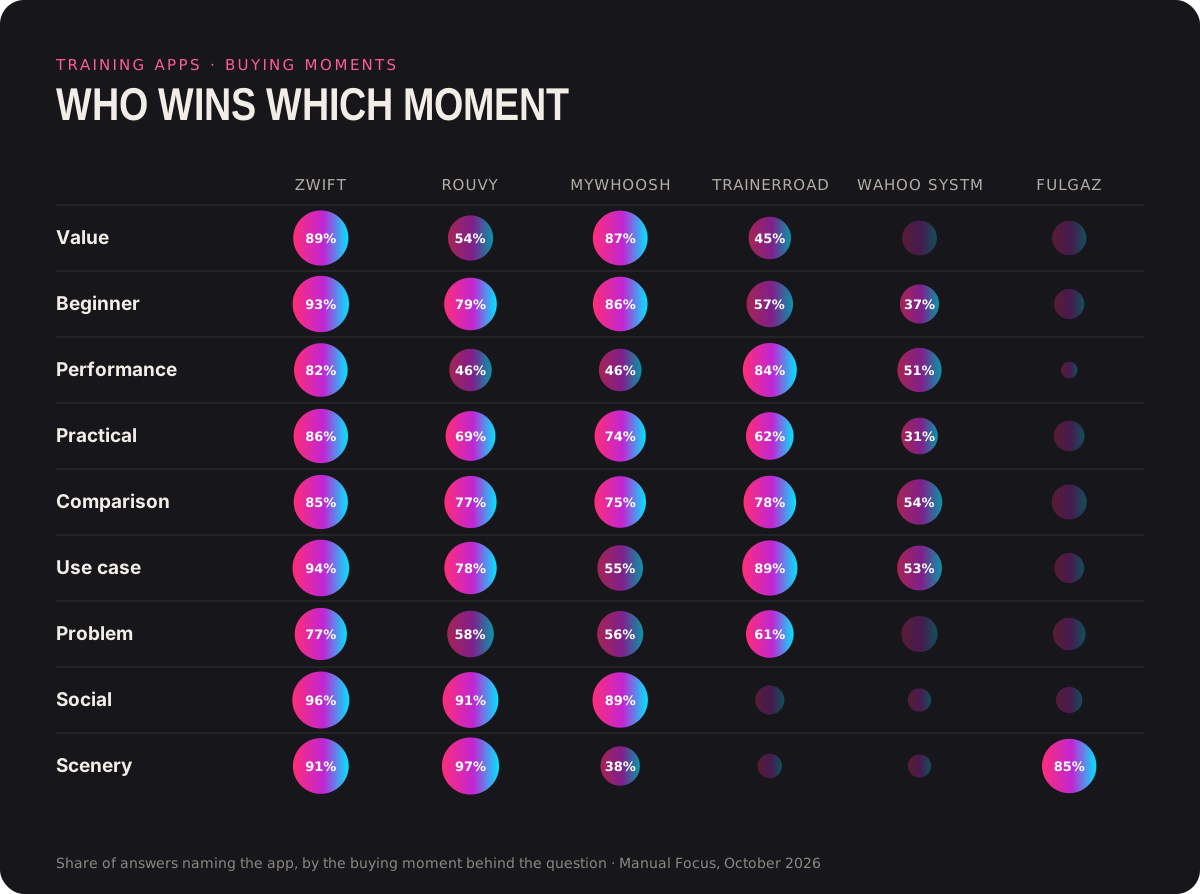
The category entry points playbook is the method for mapping these moments in your own category before you measure them.
Do the AI engines agree?
At the top, yes. Every engine put Wahoo first for trainers and Zwift first for apps. Further down the list the engines behave like different shops with different buyers.
Claude names more brands per answer than any other engine, 4.2 on average against 2.9 to 3.3 for the rest. Saris appears in 40% of Claude’s trainer answers and under 10% of every other engine’s. Van Rysel appears in 43% of Claude’s trainer answers and 37% of ChatGPT’s, but in only 5% of Google AI Mode’s.
Because AI Overviews appeared for only 64% of these searches, they give the lowest rate for most leading brands, including Wahoo, Tacx, Zwift and Wattbike.
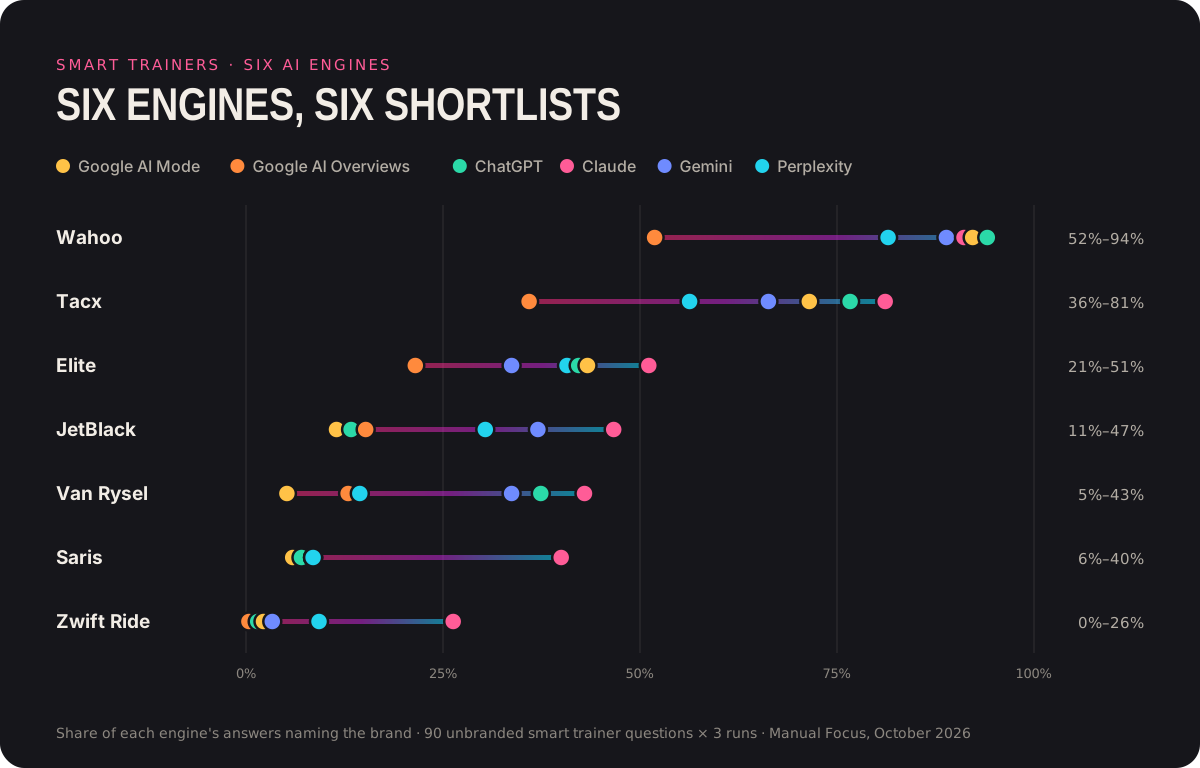
Our view at Manual Focus is that a brand team should treat each engine as a separate channel with its own shortlist, because a single “AI visibility” score averages away the gaps a challenger brand can actually close.
Which sites decide the answer?
Cycling media supplies most of the sources. Editorial sites supplied 56% of citations for trainers, 53% for smart bikes and 51% for apps, led by BikeRadar, Cyclingnews and Cycling Weekly. Reddit, YouTube and forums supplied 3% to 5%. Brand websites mattered most for apps, at 30% of citations, where Rouvy’s and MyWhoosh’s own pages were cited in a large share of answers.
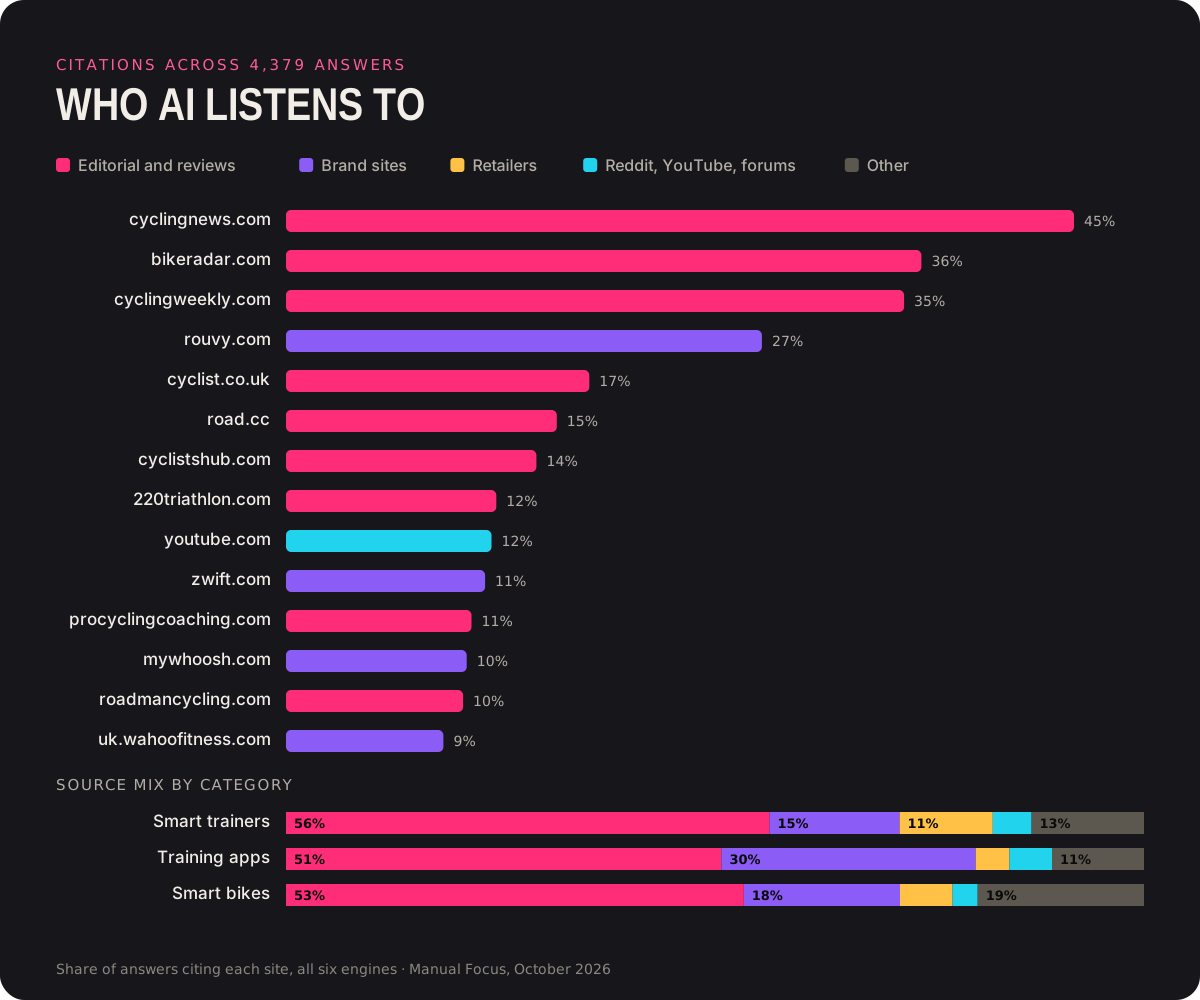
So the work for a brand team is mostly earned media, in line with our earlier argument that the citation moved off the page. For an endurance brand, the review in a buyer’s guide on BikeRadar now does double duty, as the article a rider reads and as the source an AI engine quotes. The earned media pitch generator and the SEO playbook for premium endurance brands cover how to earn those placements.
What to do with this
- Find your buying moments. List the five questions a buyer in your category asks most and check which brands AI names for each one, starting with the moment you most need to win.
- Check every engine separately. Run your top questions through ChatGPT, Gemini, Google and Claude, because your position on one says little about the others.
- Audit the cited sources. Note which buyer’s guides the engines cite for your category, then check whether your products appear in them and whether the details are current.
- Fix your own pages for the questions brand sites win. App and software brands get cited directly, so answer value, compatibility and beginner questions plainly on your own site.
- Measure again in three months, using the same questions, because a single snapshot can’t show whether your work moved anything.
What this study can’t tell you
The study counts whether AI names a brand, not whether it praises the brand, and not whether anyone buys. Logged-in users with chat history may see different answers. Perplexity and Claude were measured through their APIs, which can differ from their apps. This is a snapshot of October 2026.
Disclosure, James Vickers has previously worked with Wahoo and Wattbike and was on the founding team at RGT Cycling, which Wahoo acquired. He currently works with Ribble Cycles, which isn’t ranked but appears as a cited retailer in 19 of the 5,562 answers. No brand paid for or saw this research before publication.
Further reading
- The interactive report, with every brand and question.
- The citation moved off the page, on why rankings stopped predicting citations.
- SEO playbook for premium endurance brands, the search groundwork behind AI visibility.
- Owned, paid and earned media explained, for the earned side that AI engines lean on.
- Category entry points, for mapping the buying moments in your own market.
If you want to know where your brand sits on the AI shortlist, talk to us.
Frequently asked questions
Which smart trainer does ChatGPT recommend in the UK?
In the Manual Focus study run on 19 October 2026, ChatGPT named Wahoo in 94% of its answers to unbranded UK smart trainer questions, followed by Tacx in 77% and Elite in 42%. It also named Van Rysel, Decathlon's own brand, in 37% of answers, far more often than Google AI Mode did at 5%.
Which indoor cycling app does AI recommend most?
Zwift appeared in 88% of answers across six AI engines in the Manual Focus study of 90 unbranded UK app questions. Rouvy (71%) and MyWhoosh (69%) followed. The leader changes by buying moment, with Rouvy named in 97% of answers about scenery and MyWhoosh in 87% of answers about value.
Which smart bike does AI recommend in the UK?
Wahoo appeared in 64% of answers to unbranded UK smart bike questions across six AI engines in the Manual Focus study, with Wattbike close behind at 58% and Zwift Ride at 49%. Wahoo led performance questions at 89%, while Peloton was named most often for beginner questions, at 67%.
Do different AI engines recommend the same brands?
Mostly at the top, much less below it. All six engines put Wahoo first for smart trainers and Zwift first for apps. Challenger brands vary widely, so JetBlack appeared in 47% of Claude's trainer answers and 11% of Google AI Mode's. Asked the same question three times, an engine named exactly the same set of brands only 20% of the time.
Which websites do AI engines cite for cycling kit?
Editorial cycling media supplied more than half of the citations in the Manual Focus study, led by BikeRadar, Cyclingnews and Cycling Weekly. Reddit, YouTube and forums made up only 3% to 5% of citations. For training apps, the brands' own websites carried more weight, at 30% of citations.
Sources
- AI Shortlist research, UK indoor cycling, full interactive report, Manual Focus
- Google I/O 2026, Sundar Pichai's opening keynote, Google
- From apps to AI search, how the UK goes online in 2025, Ofcom
- Google users are less likely to click on links when an AI summary appears in the results, Pew Research Center
- AI recommendations change with nearly every query, SparkToro study, Search Engine Journal
- AI Optimization API documentation, DataForSEO
From the podcast
James and Hannah walk through the first Manual Focus AI Shortlist study: six AI engines, 309 UK questions on smart trainers, training apps and smart bikes, each asked three times, for 5,562 answers. Wahoo leads trainers at 83% and Zwift leads apps at 88%, with Wahoo and Wattbike close on smart bikes. But the leader changes with the buying moment, the engines disagree on challenger brands, the same question gives the same brands only 20% of the time, and cycling media supplies over half the citations. They finish with three jobs to hand to AI and what the study can’t tell you. The interactive report and a free one-page AI Shortlist card for brands in the study are on manual-focus.co.uk.
Get AI on this
Paste these into whichever AI assistant you use: ChatGPT, Claude, Gemini or Copilot. Swap the bracketed parts for your own details. The first needs file uploads. The second needs an assistant that can run searches on other engines or a person to paste the answers in, plus a schedule. The third needs web browsing.
1. Map your buying moments
I run marketing for [brand], which sells [category] in the UK.

I want the questions buyers ask before they choose a brand in my category,
grouped by the buying moment behind them. Use these moments: value,
beginner, performance, problem (something isn't working), and any others the
data shows.

Attached are:
- a Search Console export of queries for the last 3 months
- our customer service tags or ticket subjects for the same period

From these, write the 20 questions a buyer in [category] asks most, phrased
the way a UK buyer would type them into an AI assistant, with no brand names
in the question. Tag each with its buying moment.

Give me a table with the columns: Question | Buying moment | Evidence (the
queries or tags it came from) | Why it matters for us.

Then name the one buying moment we most need to win and say why. Don't
invent search volumes; if a figure isn't in the files, say so.
2. Check each engine separately
Set this up as a routine that runs on the first Monday of each month.

Here are 10 unbranded buyer questions for [category] in the UK:
[paste questions]

For each question, get the answer from each AI engine we track: [list the
engines you can reach, for example your own assistant plus Google's AI
answers]. Ask each question three times per engine, in a fresh
conversation each time, set to a UK location where possible. If you can't
reach an engine yourself, tell me and give me a simple form so a person can
paste the answers in.

Record which brands each answer names. Then give me a table with the
columns: Engine | Question | Brands named (all three runs) | Times [brand]
was named (0 to 3) | Times each of [competitor 1], [competitor 2] and
[competitor 3] was named.

Finish with our shortlist rate per engine (answers naming us divided by all
answers), the change since last month, and the engine where we're weakest.
Say plainly which runs you couldn't complete.
3. Audit the sites AI cites
I run marketing for [brand] in [category], UK.

Search for the buyer's guides, reviews and round-ups most likely to be cited
when someone asks an AI engine to recommend a [category product] in the UK.
Start with the specialist titles for [category], then any others that rank for
these questions: [paste 5 of your buyer questions].

For each guide, give me a table with the columns: Site | Guide title | URL |
Date last updated | Is [brand] included? | Which of our products, and is the
detail current (price, specs, model name)? | Who is listed instead of us.

Then give me a short hit list: the five guides where getting included or
corrected would matter most, and why. Don't guess at a guide's contents;
if you couldn't open it, mark it "not checked".
Read the episode transcript
James: This one's different. It isn't a news story, it's our own research, the first Manual Focus AI Shortlist. We asked AI engines which indoor cycling brands a UK rider should buy, and counted who they named. I'm James Vickers, this is Manual Focus, and Hannah's here to take it apart with me.
Hannah: Hi James. The method in one breath. Six engines, three hundred and nine UK questions, each asked three times, which gave us five thousand five hundred and sixty-two answers. The engines were ChatGPT, Gemini, Google AI Overviews, Google AI Mode, Perplexity and Claude, all set to a UK location.
James: Before we go further, a disclosure, said once and plainly. I've worked with Wahoo and Wattbike in the past, I was on the founding team at RGT Cycling, which Wahoo acquired, and I currently work with Ribble, which isn't ranked in this study. No brand paid for this research or saw it before it went out.
Hannah: And the headline numbers only use the two hundred and sixty questions that don't name a brand. Questions like "quietest smart trainer for a flat".
James: So who's on the shortlist?
Hannah: For smart trainers, Wahoo, named in eighty-three per cent of answers, and every one of the six engines put it first. Tacx is second at sixty-five, Elite third at thirty-nine. For training apps, Zwift leads at eighty-eight per cent, with Rouvy and MyWhoosh effectively tied behind it. Smart bikes are much closer. Wahoo at sixty-four per cent, Wattbike at fifty-eight.
James: So the leaders are the brands you'd expect. Where it gets useful for a brand team is underneath that.
Hannah: The leader changes with the question behind the search. We tagged every question with its buying moment. Ask about scenery and Rouvy is named in ninety-seven per cent of app answers. Ask about value and MyWhoosh is at eighty-seven. Ask about performance training and TrainerRoad leads at eighty-four.
James: And trainers?
Hannah: Van Rysel, Decathlon's own brand, turns up in roughly half of value answers and nine per cent of performance answers. For smart bikes, Peloton leads the beginner moment, which tells you something about who AI thinks a beginner is.
James: A fitness brand winning the cycling beginners. That's the bit I'd want on a slide. A brand can own performance and still be missing from the shortlist a first-time buyer sees.
Hannah: Then the engines themselves. At the top they agree. Below it, they behave like different shops. Claude names more brands per answer, four point two on average against roughly three for the rest. JetBlack appears in forty-seven per cent of Claude's trainer answers and eleven per cent of Google AI Mode's.
James: So there's no single AI shortlist.
Hannah: There isn't even a stable one inside a single engine. Ask the same question three times and an engine named exactly the same set of brands only twenty per cent of the time. ChatGPT was the least consistent at thirteen per cent, Perplexity the most at forty-eight.
James: Which is why we measured how often a brand appears, not where it ranks. SparkToro gave brands the same advice in January.
Hannah: And one thing Google watchers will notice. An AI Overview appeared on sixty-four per cent of these searches, well above the roughly thirty per cent Ofcom found across all UK searches. Shopping questions pull the AI answer in.
James: Our view at Manual Focus is that every engine should be treated as its own channel with its own shortlist. A single "AI visibility" score averages away exactly the gaps a challenger can close. Now, the obvious next question. Where does the AI get all this from?
Hannah: Mostly cycling media. Editorial sites supplied between fifty-one and fifty-six per cent of the citations, led by BikeRadar, Cyclingnews and Cycling Weekly. Reddit, YouTube and forums supplied three to five per cent. The exception is apps, where the brands' own websites carried thirty per cent of the citations.
James: When we covered the citation moving off the page back in June, the argument was that rankings had stopped predicting who AI quotes. This is what that looks like in one category. The buyer's guide review on BikeRadar now does two jobs. The rider reads it, and the engine quotes it.
Hannah: So the work for most brands is earned media, not just their own pages.
James: Right, so how do you act on this without a research team? Get AI on this.
Hannah: Go on.
James: First, get your AI to map your buying moments. The five questions a buyer in your category asks most, tagged by moment, value, beginner, performance, problem.
Hannah: Give it your search queries and your customer service tags, and it hands you the list with the moment you most need to win at the top.
James: Second, check each engine separately. Your position on one says very little about the others.
Hannah: Set it up as a routine. Run the same questions three times on each engine, record which brands each answer names, and track how often you appear, because a single answer tells you very little.
James: Third, audit the sites AI cites. Have your AI list the buyer's guides the engines cite for your category, then check whether your products are in them and whether the details are current.
Hannah: The output is a hit list for your PR team. Getting into those guides is still a human job.
James: The prompts for all three are in the show notes.
Hannah: And what this study can't tell you. It counts whether AI names a brand, not whether it praises it, and not whether anyone buys. Logged-in users with chat history may see different answers. Perplexity and Claude were measured through their APIs, which can differ from their apps. And it's a snapshot of October twenty twenty-six.
James: So the takeaway. For a UK rider asking AI what to buy, the shortlist is real, it changes with the buying moment and the engine, and cycling media writes most of it. The interactive report has every brand and every question, and it's on manual-focus dot co dot uk.
Hannah: And if your brand is in the study, you can ask for a free one-page AI Shortlist card there too.
James: If this was useful, follow the show in Apple Podcasts, Spotify or wherever you listen. And if you'd like to know where your own brand sits, book a free working session with us at manual-focus dot co dot uk. Thanks, Hannah.
Hannah: Thanks, James.