On 19 October 2026 Manual Focus asked six AI engines 309 UK questions about indoor cycling, three times each. In the 4,379 answers to unbranded questions, a few buyer’s guides carried most of the citations. BikeRadar’s smart trainer guide alone was cited in 55% of smart trainer answers, more than any brand’s own website.
The first write-up of the study covered which brands AI names. When BikeBiz reported the results on 23 October, it asked James what they mean for brand strategy. His answer started with the sources AI cites, so this post goes through them page by page and engine by engine, using the same data as the interactive report.
Key takeaways
- BikeRadar’s best smart trainer guide was cited in 55% of AI answers to unbranded UK smart trainer questions.
- Cyclingnews was the most cited site in the study, in 45% of all answers. At least one of the three biggest cycling titles appeared in 65%.
- Perplexity cited at least one of those three titles in 90% of its answers. Google AI Mode did so in 26%.
- YouTube appeared in 65% of Google AI Overviews but in only 2 of ChatGPT’s 780 answers.
- Pages on Rouvy’s own blog were cited in 30% of training app answers, more often than Cyclist or road.cc.
Which pages does AI cite most?
Across the study, 92% of answers cited at least one website. Between them the engines cited 1,112 different domains. Most of that list is long tail, since the ten most cited domains made up 42% of all citations. In each category, one or two buyer’s guides turned up in about half the answers.
| Category | Most cited page | Share of answers | Second page | Share of answers |
|---|---|---|---|---|
| Smart trainers | BikeRadar, best smart trainers | 55% | Cyclingnews, best turbo trainers | 49% |
| Training apps | Cyclingnews, indoor cycling apps | 64% | Cycling Weekly, indoor cycling apps | 52% |
| Smart bikes | Cyclingnews, best smart bikes | 53% | Cycling Weekly, best smart bikes | 49% |
Each share is the proportion of answers in that category that cited the page at least once.
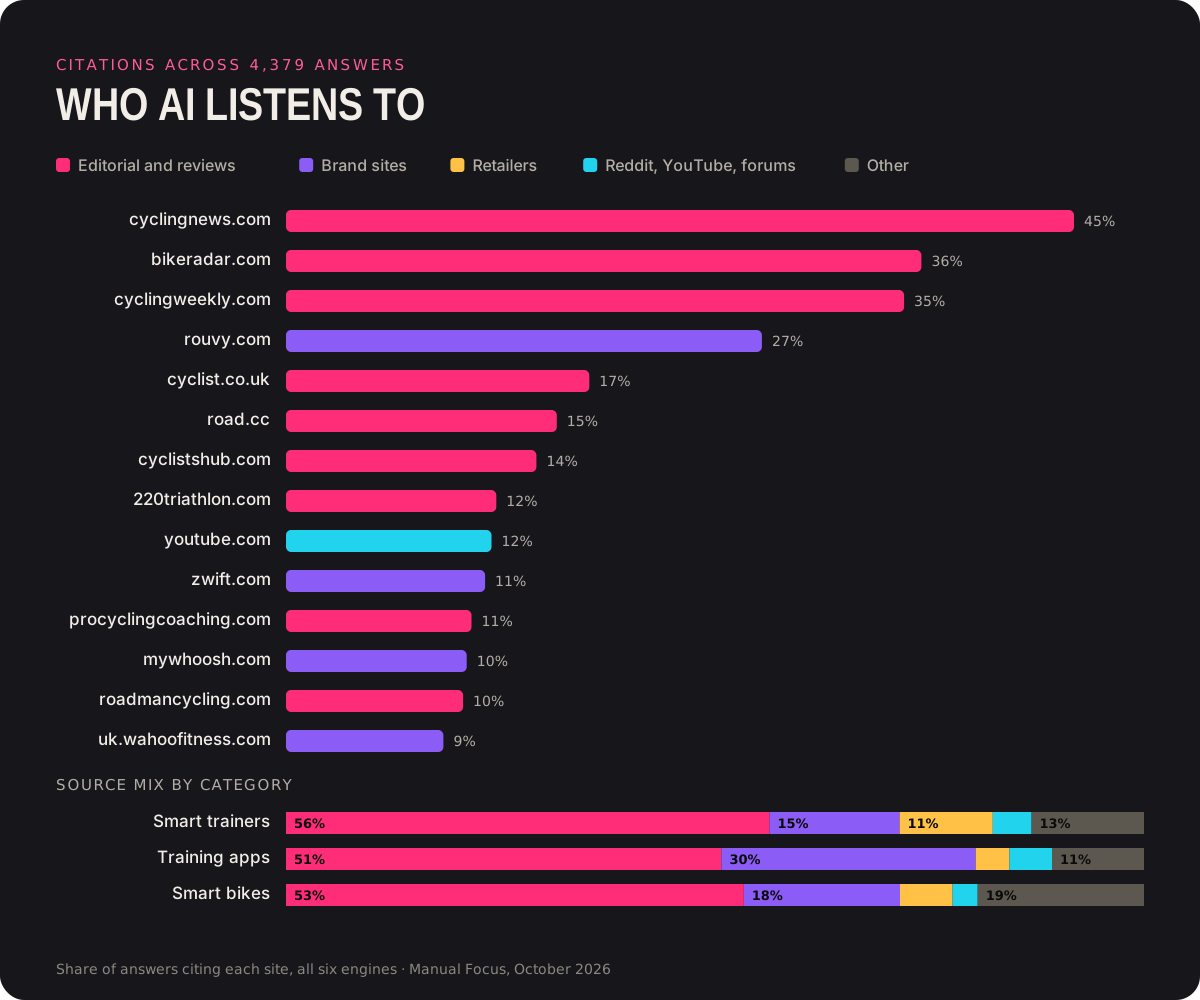
For a trainer brand, the BikeRadar guide is close to a single point of failure. A product missing from it is missing from the page most AI answers lean on.
Does every engine use the same sources?
No. Perplexity and Gemini cite the most sites per answer and lean hardest on cycling media. Google’s two search engines rely on those titles least.
| Engine | Answers citing a site | Sites cited per answer | Cites one of the big three titles | Cites YouTube |
|---|---|---|---|---|
| Perplexity | 100% | 7.7 | 90% | 0% |
| Gemini | 92% | 6.1 | 83% | 6% |
| ChatGPT | 97% | 5.7 | 73% | Under 1% |
| Claude | 91% | 5.0 | 67% | 0% |
| Google AI Overviews | 99% | 5.2 | 42% | 65% |
| Google AI Mode | 74% | 2.2 | 26% | 20% |
The big three are the most cited titles overall, Cyclingnews first, then BikeRadar, then Cycling Weekly. AI Overviews figures cover the 479 answers where Google showed an overview.
Google AI Mode is the outlier. A quarter of its answers cite no site at all. Its most cited source is Cyclist, in 23% of answers, rather than any of the big three. The BikeRadar trainer guide that Perplexity cited in 71% of trainer answers appeared in 4% of AI Mode’s.
Where do YouTube and Reddit fit?
Mostly inside Google Search. Video and forum sites made up 3% to 5% of all citations in the original study, but that average hides a split. In Google AI Overviews, community sites made up 21% of everything cited. YouTube was cited in 309 of 479 overviews, Reddit in 94.
Outside Google Search, the picture reverses. Claude cited neither site in any of its 780 answers. Perplexity never cited YouTube. Reddit’s own plans make this harder to predict, as we covered in Reddit’s move to a logged-in-only site.
So a brand that relies only on written reviews misses much of what AI Overviews cite, while one that relies only on YouTube creators gets little from Claude or Perplexity.
Can a brand’s own site get cited?
Yes, though how often depends heavily on the engine. Brand websites made up 41% of the sites ChatGPT cited, the highest of any engine. It cited zwift.com in 37% of its answers and Wahoo’s UK site in 25%. Claude went the other way, with brand sites at 10% of its citations.
Rouvy was the most cited brand website in the study, in 27% of all answers. Pages on its blog were cited in 30% of app answers, more often than Cyclist at 23% or road.cc at 18%. Perplexity cited them in 67% of its app answers and Claude in 52%. Rouvy was named in 89% of the app answers that cited one of those pages, against 68% of those that didn’t. That gap is a correlation, since an engine that already favours Rouvy may also pick its pages.
The most cited of those pages reads like a buyer’s guide. It compares Rouvy with rivals such as Zwift and TrainerRoad, in the same format as the cycling media guides the engines cite. Structure helps too, as the SISTRIX citation study found tables of contents went with more AI citations across 96,418 URLs.
Where do retailers come in?
At the point of purchase. Across every other buying moment, retailers supplied 3% to 12% of cited sites. For UK buying questions, such as where to buy a trainer in the UK, their share rose to 31%.
| Retailer | Share of UK buying answers citing it |
|---|---|
| Fitshop | 22% |
| Decathlon | 19% |
| Tredz | 19% |
| Sigma Sports | 18% |
| Halfords | 8% |
A brand’s distribution shows up in AI answers through these pages, so current prices and stock on those listings matter most here.
What should brand teams do?
Our view at Manual Focus is that an indoor cycling brand should treat a short list of buyer’s guides as its most important AI channel, because the top guides appear in more answers than any brand site or retailer.
- List the guides. Take the pages in the tables above and the report’s sources section, then check whether your products are in each one with current models and prices.
- Get reviewed where it counts. Put review samples and briefings in front of the editors behind those guides before chasing wider coverage. The earned media pitch generator helps plan the story. Earned channels in the AI era covers how journalists now work.
- Cover video for Google. If AI Overviews matter to you, make sure honest video reviews of your product exist on YouTube, since 65% of the overviews in this study cited it.
- Publish one honest comparison page. Rouvy’s most cited page compares it with named rivals, which a page about one product can’t do.
- Check by engine. Run your own top questions in Perplexity and Google AI Mode at least, since they cite the most different sources. Manual Focus Light Meter does this at scale, three runs per question, with the sources logged.
Bing’s Topics Portfolio report also shows where other sites get cited and yours does not, which is a free place to start.
What this cut can’t tell you
The data shows which pages AI cites. It can’t show why, or whether a citation changes what a rider buys. Logged-in users may see different sources. Perplexity and Claude were measured through their APIs, which can differ from their apps. A buyer’s guide can be rewritten next month, so these shares describe October 2026 only.
Disclosure, James Vickers previously worked at Wahoo and Wattbike and was on the founding team at RGT Cycling, which Wahoo acquired. No brand paid for or saw this research before publication.
Further reading
- Which indoor cycling brands does AI recommend?, the original study and its brand rankings.
- The interactive report, with every brand, question and source.
- Manual Focus Light Meter, the open-source tool behind the study.
- The citation moved off the page, on why ranking stopped predicting citations.
- Earned channels in the AI era, on earning coverage when journalists use AI too.
If you want to know which pages decide your own category’s AI answers, talk to us.
Frequently asked questions
Which website does AI cite most for smart trainers?
In the Manual Focus AI Shortlist study of October 2026, BikeRadar's best smart trainer guide was cited in 55% of AI answers to unbranded UK smart trainer questions. The Cyclingnews guide to the best turbo trainers came second at 49%. Perplexity cited the BikeRadar page in 71% of its trainer answers and Google AI Mode in 4%.
Does Google AI Overviews cite YouTube?
Often, for cycling kit. YouTube appeared in 65% of the Google AI Overviews shown for UK indoor cycling questions in the Manual Focus study, which made it the most cited source for that engine. ChatGPT cited YouTube in 2 of its 780 answers. Perplexity and Claude cited it in none.
Can a brand's own website be cited by AI?
Yes, mostly for apps and mostly on ChatGPT. In the Manual Focus study, brand websites made up 41% of the sites ChatGPT cited for indoor cycling, against 10% for Claude. Pages on Rouvy's own blog were cited in 30% of answers to training app questions, more often than Cyclist or road.cc.
Which retailers does AI cite for indoor cycling kit in the UK?
Retailers mostly appear when people ask where to buy. For UK buying questions in the Manual Focus study, retailers supplied 31% of cited sites. Fitshop was cited in 22% of those answers, Decathlon and Tredz in 19% each, then Sigma Sports in 18%.
Sources
From the podcast
James and Hannah go through the second cut of the Manual Focus AI Shortlist study of UK indoor cycling: the websites six AI engines cited in 4,379 answers. One BikeRadar buyer’s guide was cited in 55% of smart trainer answers, but each engine leans on different sources. Google AI Overviews cited YouTube in 65% of its answers while Claude never did, and ChatGPT cited brand websites more than any other engine. They cover Rouvy’s own blog, where retailers come in, and three jobs to hand to AI.
Get AI on this
Paste these into whichever AI assistant you use. Swap the bracketed parts for your own details. The first two need file uploads or pasted text. The third needs an assistant that can browse the web and run on a schedule.
1. Audit the buyer’s guides AI cites
I run marketing for [brand], which sells [product category] in [market].

AI engines lean heavily on a small number of buyer's guides when they answer
shopping questions in our category. I want to know whether our products are in
the guides that matter, and whether what those guides say about us is current.

Attached are:
- a list of the buyer's guide URLs AI engines cite most for our category
- our current product range, with model names, launch dates and UK prices

Open each guide and check it against our range.

Give me a table with the columns: Guide | Publisher | Last updated (as shown on
the page) | Our product included (yes or no) | Model named | Price shown |
What's out of date or missing.

Then list the three guides where getting in, or getting updated, would matter
most, with one line on why for each.

If a page won't open, or doesn't show a date or price, say so in the table
rather than guessing.
2. Draft a fair comparison page
I run marketing for [brand], which makes [product]. I want to publish a
comparison page on our site that a buyer, or an AI engine, would trust as much
as an independent buyer's guide.

Attached are:
- our spec sheet and UK prices for [product]
- the public product pages or spec sheets for [rival 1], [rival 2] and
  [rival 3]

Draft a comparison page of 800 to 1,200 words for the question "[the buyer
question you want to answer]". Include:
- a short answer at the top, saying which product suits which kind of buyer
- a comparison table with the columns: Product | Price | [three specs that
  matter to buyers in this category]
- one section per product, including ours, with its genuine strengths and
  weaknesses

Be fair to the rivals. Where a rival beats us on something, say so. Use only
facts from the attached files, and mark any spec you couldn't confirm as
"to check" rather than filling it in.
3. Run a monthly engine check
Each month, run this check for [brand] in [market]. This needs web access and
a schedule.

Here are our ten most important buyer questions:
[question 1]
[question 2]
...
[question 10]

For each question, ask it as a UK shopper would, in a fresh conversation with
no brand named, in each AI engine you can reach.

Give me a table with the columns: Question | Engine | Brands named, in order |
Whether [brand] was named | Websites cited.

Then give me:
- how many answers named [brand], by engine
- the five websites cited most often, and whether each one mentions [brand]
- what changed since last month's table, if I paste it in

Say which engines you couldn't reach or which answers showed no sources,
rather than leaving gaps unexplained.
Read the episode transcript
James: If you sell smart trainers in the UK, one page on BikeRadar turns up in more than half the AI answers your buyers read. That's from the second cut of our own indoor cycling research. I'm James Vickers, this is Manual Focus, and Hannah's back to go through where AI gets its cycling advice.
Hannah: Thanks, James. In October we asked six AI engines three hundred and nine UK questions about indoor cycling, three times each. Last time we covered which brands they named. This time it's the websites they cited.
James: And a disclosure before we start. I used to work at Wahoo and Wattbike, and I was on the founding team at RGT Cycling, which Wahoo acquired. No brand paid for this research or saw it before it went out.
Hannah: So, the headline. Across four thousand three hundred and seventy-nine answers to questions that don't name a brand, ninety-two per cent cited at least one website. The engines cited over eleven hundred different sites between them.
James: Which sounds spread out.
Hannah: It isn't, really. One or two buyer's guides turned up in about half the answers in each category. BikeRadar's best smart trainers guide was cited in fifty-five per cent of trainer answers. For training apps, the Cyclingnews guide was in sixty-four per cent. For smart bikes, Cyclingnews again, at fifty-three.
James: So for a trainer brand, that one BikeRadar page is close to a single point of failure. If your product isn't in it, you're missing from the page most of these answers lean on. When BikeBiz covered the first results, they asked me what it all meant for brands, and that was my answer. So, do all six engines read the same pages?
Hannah: No, and that's the most useful part. Perplexity cites the most, nearly eight sites per answer, and ninety per cent of its answers cite at least one of the big three titles, so Cyclingnews, BikeRadar or Cycling Weekly. Gemini is at eighty-three per cent. Google AI Mode is at twenty-six.
James: Why is AI Mode so far behind?
Hannah: We can't say why, only what it does. A quarter of its answers cite no website at all, and it averages about two sites per answer. Its favourite source is Cyclist, not any of the big three. That BikeRadar trainer guide Perplexity cited in seventy-one per cent of trainer answers? AI Mode cited it in four.
James: So being in the BikeRadar guide matters a lot for Perplexity and very little for AI Mode.
Hannah: Pretty much. Then there's YouTube. In the first study, video and forum sites were only three to five per cent of citations. But that average hides a split. Google's AI Overviews cited YouTube in sixty-five per cent of the overviews we saw. ChatGPT cited it twice in seven hundred and eighty answers. Claude and Perplexity, never.
James: So if Google is the engine you care about, honest video reviews of your product matter. If it's Claude or Perplexity, the written guides do the work.
Hannah: That's the read. Reddit sits in the same place, mostly inside Google Search, which matters given Reddit's plan for a logged-in-only site that we covered a couple of weeks ago.
James: Can a brand's own website get cited, or is it all media?
Hannah: It can, and ChatGPT is the engine most likely to do it. Brand websites were forty-one per cent of what ChatGPT cited. It cited Zwift's site in thirty-seven per cent of its answers and Wahoo's UK site in a quarter. Claude went the other way, at ten per cent.
James: And Rouvy?
Hannah: Rouvy was the most cited brand site in the whole study. Pages on its blog were cited in thirty per cent of training app answers, more often than Cyclist or road dot cc. The most cited one reads like a buyer's guide. It compares Rouvy with rivals like Zwift and TrainerRoad.
James: Does that page win Rouvy the recommendation?
Hannah: We can't prove it. Rouvy was named in eighty-nine per cent of app answers that cited its blog, against sixty-eight per cent of the ones that didn't. But an engine that already likes Rouvy might also pick its pages. It's a correlation.
James: And retailers?
Hannah: They come in at the till. For most kinds of question, retailers were three to twelve per cent of what got cited. Ask where to buy in the UK and it jumps to thirty-one per cent, with Fitshop, Decathlon, Tredz and Sigma Sports cited most.
James: Our view at Manual Focus is that an indoor cycling brand should treat a short list of buyer's guides as its most important AI channel. The top guides appear in more answers than any brand site or retailer. So, what do you hand to AI?
Hannah: Go on.
James: Get AI on this. First, the guide audit. Make a list of the buyer's guides the engines cite for your category, and have AI check whether your current models and prices are in each one.
Hannah: Give it the page list from the report and your current range with prices. It hands back a table of each guide, whether you're in it, which model it shows, and what's out of date. The pitch to the editor stays with a person.
James: Second, the comparison page. If you're going to publish one, have AI draft it from your own spec sheets and your rivals' public pages.
Hannah: And tell it to be fair to the rivals, because the page that got cited in this study compared real competitors. You check every claim before it goes up.
James: Third, a monthly engine check. Your top ten buyer questions, run through each engine, with the brands and cited sites logged.
Hannah: That needs a tool that can browse and run on a schedule, so set it up as a monthly routine. The prompts are in the show notes.
James: What don't we know?
Hannah: Why any engine picks a source, for a start. We see what gets cited, not the reasoning. We don't know whether a citation changes what a rider buys. Logged-in users may see different sources, and we measured Perplexity and Claude through their APIs, which can differ from the apps. And a buyer's guide can be rewritten next month, so this is October twenty twenty-six.
James: So the takeaway is that the AI shortlist for cycling kit leans on a few buyer's guides, and which ones depends on the engine. The full article, with the page-by-page tables, is on manual-focus dot co dot uk. Follow Manual Focus in Apple Podcasts, Spotify or wherever you're listening, and if you want to see which pages shape the answers in your own category, book a free working session with us at manual-focus dot co dot uk.
Hannah: See you next time.