The Rider Panel is the market research part of Light Meter. It builds a simulated world of AI agents before a product launches. Each agent lives a life the launch has to fit into. Philippa Hallam, one of the first 500, is a 55-year-old architect who cut back to three days a week after her children left home. Her husband has an equal say in anything costly. She has waited ten years to ride the Fred Whitton. Agents like her already own kit, train on an app they know and have a shop they usually use. They see every rival product at its real price, with its real Black Friday deal. They only come across the brands someone like them would meet. Then we put a launch in front of them. Each one decides, month by month, whether to buy.
For our first mock study, we built 500 AI agents, each a simulated UK cyclist shopping for an indoor trainer this season, from a potentially limitless pool of agents the Rider Panel has access to. Five hundred is enough to tell a real change from noise.
One agent can end the season up to 86 different ways, buying one of 12 trainers or other options in any of seven months, or not buying at all. Five agents can end it 4.7 billion ways. For all 500, the count is a number about 970 digits long. Across four launch plans plus our checks, the agents lived 2,200 seasons. That’s about 9,300 months of shopping, each one written up in the agent’s own diary. We then re-sampled the results 12,000 times to measure how sure we can be.
We gave them a new folding smart trainer at £499. With the big reviews out at launch, 26 of them bought it. Without reviews, 3 did. At £399 for Black Friday, 41 did. Then every one of them told us why.
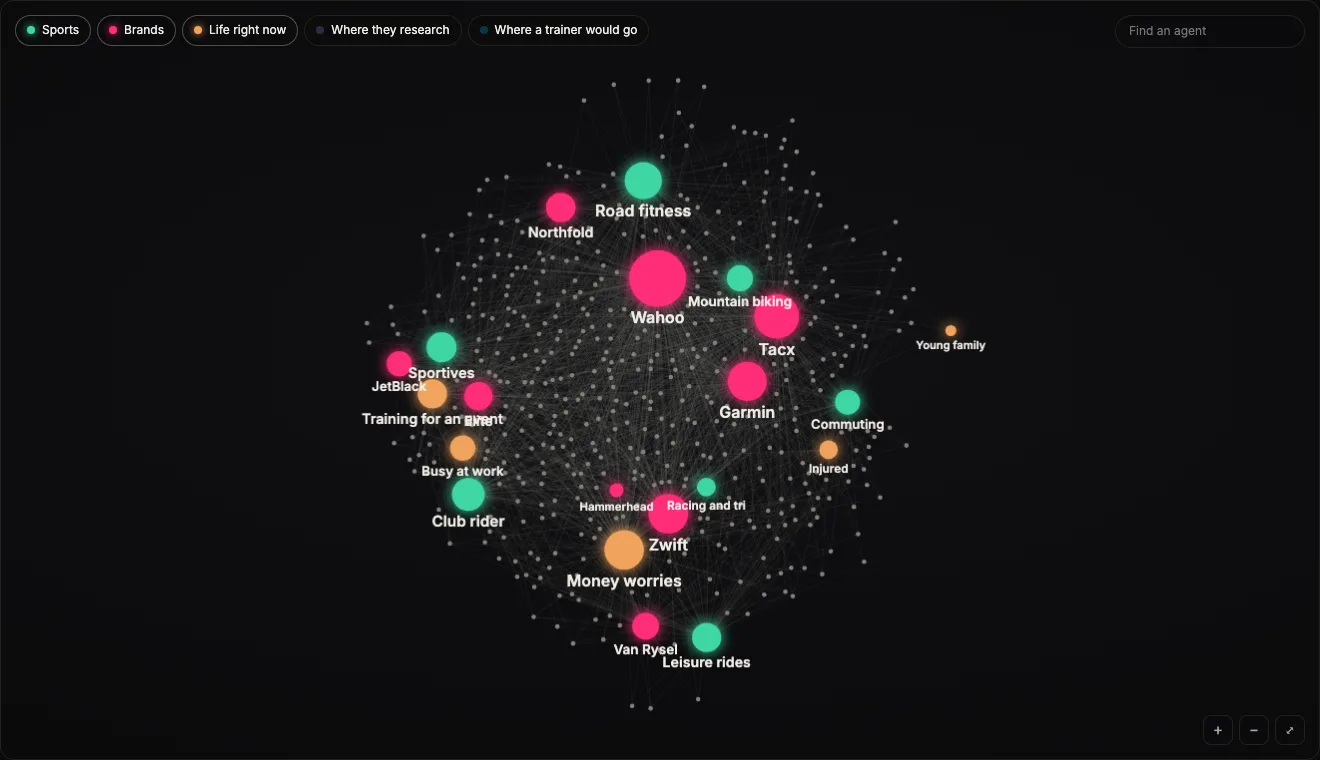
The 500 agents as a knowledge graph. Each small dot is an agent. Each large dot is something they share, from Wahoo to money worries. In the interactive report, you can click any agent to see their connections.
Brands can ask about a Rider Panel study for their own launch.
Key takeaways
- Without independent reviews, a new trainer brand sold to 3 agents in 500 instead of 26. Nobody wanted to be the guinea pig.
- A £399 Black Friday price took it to 41 buyers with 38% more revenue. The agents had asked for it.
- Being named by AI engines added a little, from 26 buyers to 33.
- Buyers chose it because it folds flat to 14cm and it’s quiet. Most of them had nowhere to keep a trainer.
- Agents who walked away were waiting for a sale or didn’t trust a brand they’d never heard of.
- The 500 agents were recruited from a potentially limitless pool. A brand’s study can be as big as the question needs.
What is the Rider Panel?
Market research usually means asking real people what they would do. That takes weeks to recruit and costs thousands of pounds per study, so most brands only do it for their biggest launches. Everything else gets decided on instinct.
The Rider Panel is part of Light Meter, our research tool. Light Meter’s AI visibility studies show what AI tells shoppers. The Rider Panel shows what shoppers then do.
A brand describes a launch. Every agent lives the season month by month and decides whether to buy. Each one explains the choice in their own words. Agents who walk away also say what would have changed their mind. It takes days rather than months. It doesn’t replace real customers. It shows which plans are worth taking to them.
The panel has no fixed size. We can recruit as many agents as a question needs from the same pool, for whichever market it’s about.
Who the 500 agents are
They’re the people who go shopping for an indoor trainer this season, not every cyclist. Most cyclists never think about a trainer in a given year. A panel of all cyclists would put people in the market who’d never be there.
We built 200,000 UK cyclists first, using survey data. Sport England’s Active Lives survey sets who rides. The English Housing Survey decides who rents or owns their home. Each cyclist then got a chance of shopping this season, based on what they ride indoors now and what’s wrong with it. We recruited the 500 from everyone who shops. About 2 in 100 adult cyclists shop for a trainer in a season, on our estimate. The report gives the sources and working for every market figure.
| Part of an agent’s world | Where it comes from |
|---|---|
| Their life | UK survey data, plus a written life story with a reason to start looking |
| Their kit | The bike computer they own, how much its brand matters to them, their cassette and app |
| Weather | Each town’s real monthly weather, September 2025 to March 2026, from Open-Meteo |
| The season | The clocks going back, Black Friday, Christmas costs, the January sales |
| Prices and rivals | 10 real rival trainers at UK prices, with Black Friday and January deals |
| What they come across | Brand familiarity from UK search share, plus each agent’s own shops and apps |
Jonty Ellerby is a police officer in York with two young children and a rented house that has no spare room. Ife Okonkwo is a GP in Islington whose old trainer wakes his toddler. Lee Hocking drives deliveries in Plymouth and was let down by the last new brand he bought.
An agent only knows the trainers someone like them would meet. A Garmin owner sees Tacx in Garmin Connect. An agent who shops at Decathlon sees Van Rysel. Someone who asks ChatGPT hears the brands it names. Our AI Shortlist study found AI engines name Wahoo in 83% of UK smart trainer answers.
How a Rider Panel study works
To prove the panel, we invented a brand called Northfold and a folding smart trainer, the DD1. Northfold isn’t a real company. The DD1 is quiet and folds flat to 14cm deep. Like its main rivals, it comes with the Zwift Cog and Click. It goes on sale on 16 November at £499. Sigma Sports and Tredz stock it, with a display stand in Halfords.
A new brand can’t be better known than an established one in its first season. So we capped Northfold’s reach at the awareness of JetBlack, a UK challenger brand, as modelled in our panel. About 110 of the 500 agents come across it. We added this cap after the full runs, when Northfold had met 65% of agents and taken 16% of the season’s sales. The 142 agents it affected decided again, with no full rerun.
Then we ran the season four times on the same 500 agents. Their lives stayed the same. So did the weather and every rival’s price.
| Run | What changes | What it shows |
|---|---|---|
| The launch as planned | £499 all season, reviews out at launch | The baseline |
| Black Friday price | £399 from 20 to 30 November | What a discount is worth |
| No reviews | No independent reviews this season | What reviews are worth |
| Named by AI | AI engines name Northfold in 45% of answers | What AI visibility is worth |
Each agent keeps a diary. Here’s Lee’s season at £499, month by month:
Knee’s calming down. Want to get past the wheel-on this winter but the flat has no room. Asked ChatGPT, said Wahoo.
Wife says we can’t justify it while my current one works. Leaving it.
Saw Northfold on a road.cc page. New brand, no thanks after the last one I bought let me down.
Black Friday on Amazon. Tempting but we’re stretched before Christmas. Skipped.
Christmas costs. Nothing bought.
Post-Christmas sale. KICKR CORE 2 at £439 on Amazon, wife agreed. Bought it.
The results of four launch plans
| Launch plan | Northfold buyers in 500 | Change vs the £499 launch | Northfold revenue in the panel |
|---|---|---|---|
| £499 all season, reviews out at launch | 26 | £12,974 | |
| £399 for Black Friday | 41 | +15, a real change | £17,859 |
| No independent reviews | 3 | −23, a real change | £1,497 |
| Named by AI engines | 33 | +7, within the margin of error | £16,467 |
A change counts as real when it’s bigger than the panel’s own noise. The rest of this article takes each plan in turn, starting with the people who bought.
Why agents bought the Northfold
22 of the 26 buyers named folding or space as a reason. 21 chose it for being quiet. 20 said the independent reviews convinced them. Most of them would have to put a trainer away after every ride.
“A three-year warranty and 30-day free returns let me back a new brand.” Jonty Ellerby, 37, police officer, York
“It’s genuinely quiet and folds away, and £499 is far less than the Neo or V6 even in the sale. DC Rainmaker’s review sold me on the accuracy.” Jamal Rowe, 23, Reading
Notice how often a new brand needed a safety net. Reviews kept coming up. So did free returns and long warranties.
Why agents walked away
65 agents considered Northfold at £499 and bought something else, or nothing.
| Reason given by the 65 | Agents |
|---|---|
| Waiting for a sale | 44 |
| The price | 40 |
| Not sure a new brand will last | 32 |
| Wanted proven accuracy | 10 |
| Money is tight | 9 |
“Money is tight, so I waited for the Black Friday price on the best-known name. Northfold costs more and had no discount.” Maggie Thorne, 54, builder, Islington
“Northfold got good reviews, but I’ve been burned by a new brand and I want one with years behind it. The Wahoo is a safe bet.” Hugh Aldridge, 47, lecturer, Croydon
“For a crit racer the V6’s 1% accuracy is the point and Wahoo is the name I trust for returns and repairs. The Northfold looked decent but I’d rather not gamble.” Samir Haddad, 37, engineer, Greenwich
That turns a sales number into a to-do list. Each of the 65 also told us what would have changed their mind.
“If the Northfold had joined the Black Friday sales at around £399, I’d have gone for it over the Rivo.” Declan Moran, 54, sales manager, Liverpool
“If a trusted club mate had actually owned a Northfold for six months and it had held up, I’d have taken a proper look.” Adrian Kowalczyk, 49, physio, Leeds
The effect of a Black Friday price
The first action came straight from the agents, so we tested it. 44 of the 65 were waiting for a sale. We ran the season again with Northfold at £399 from 20 to 30 November.
Sales rose from 26 to 41. Revenue rose 38%, even after the price cut. 20 agents who hadn’t bought it at £499 bought it at £399. A few of the £499 buyers went elsewhere, which is the panel’s normal variation showing through. 26 of the 41 bought in November. Most of the new buyers would otherwise have bought a Wahoo KICKR CORE 2, which was on its own deal that week.
Part of the gain was visibility. 9 of the 41 buyers first heard of Northfold through a deal list or a deal email. For a brand nobody knows, being on the Black Friday lists puts it in front of agents who’d never have come across it.
Revenue isn’t profit. Sold direct, the £399 plan only beats £499 all season if Northfold keeps at least £144 of the £416 it receives per trainer after VAT, which is a 35% margin.
This result depends on the reach cap. Before we added the cap, the £399 price added only 5% to revenue. A better-known brand should expect something closer to that, because it has fewer new shoppers to reach.
“The noise is the whole problem. The quiet Wahoo and Tacx cost £600, and DC Rainmaker called the Northfold genuinely quiet at £399 and it folds away in our tiny flat.” Ife Okonkwo, 30, GP, Islington. At £499 he bought a Wahoo KICKR V6.
“My living room is too small for the old trainer and this one folds flat. At £399 it matched the CORE 2’s price, but it solved my space problem.” Alasdair Menzies, 34, Perth. At £499 he put off buying altogether.
Hugh Aldridge, who wanted a brand with years behind it, changed his mind too. At £399 he said the reviews and the 30-day returns made him happy to try it despite getting burned once.
The importance of independent reviews
This was the biggest change in the study. With no independent reviews this season, from BikeRadar to DC Rainmaker, Northfold sold to 3 agents instead of 26.
Most buyers first came across Northfold some other way, such as the launch film or a bike shop. But 20 of the 26 said the reviews were what made them buy. Without them, the agents who came across it couldn’t tell whether a brand they’d never heard of was any good. Of the 23 buyers it lost, 12 bought a Wahoo KICKR CORE 2 instead.
“Everyone on Reddit and the AI said Wahoo. It comes with the cog so my older bike works, and £439 was fine. Northfold looked interesting but I didn’t want to be the guinea pig.” Folasade Adeyemi, 38, project manager, Hackney. With reviews out, she bought a Northfold.
“A BikeRadar or DC Rainmaker review of the Northfold saying it’s good would have made it a serious contender at that price.” Idris Walcott, 27, Hackney
The effect of being named by AI
When AI engines name Northfold in 45% of their answers, sales rise from 26 to 33. 8 of the 33 buyers first heard of it from AI.
“I have to put it away every ride in a rented flat and my bike is 10-speed. The AI pointed me to the fold-flat one with the Cog included and a 30-day return.” Catriona Sim, 42, warehouse supervisor, Aberdeen
That fits our AI Shortlist study. Being named gets a brand onto the list. Reviews close the sale.
What Northfold should do next
Tested by running the season again:
- Have the big reviews out on launch day. It’s the difference between 3 buyers and 26.
- Model Black Friday at £399 against your margin. In the panel it added 15 buyers and 38% more revenue. Sold direct, each £499 trainer brings Northfold £416 after VAT. The £399 plan only adds profit if Northfold keeps at least £144 of that once every cost per trainer is paid. Through a retailer taking 40%, Northfold receives £250 per trainer and needs to keep at least £87. Below those figures, the extra sales don’t cover the discount.
- Work on being named in AI answers, after the reviews rather than instead of them.
Still to test:
- Prove the brand will last. 32 of the agents who walked away didn’t trust a new brand. Test a 100-day trial with a five-year warranty on every retailer listing.
- Plan a January offer. Lee bought his trainer in the January sales. Test £449 through January.
- Aim at people with no spare room. Most buyers had to put a trainer away after every ride. Show how flat it folds, to 14cm, in the first second of every video.
What the results mean in real sales
Each of the 500 agents stands for about 284 real UK shoppers. That’s set so the £499 run’s trainer sales match the size of the UK market this season, about 120,000 trainers on our estimate. No published UK sales figure exists that we could find, so we worked it out from market revenue and confidence is low. On that basis, the £499 launch sells about 7,400 trainers, 6% of the season. The £399 Black Friday plan sells about 11,700. Without reviews it sells about 900.
Those totals rest on our market estimate, which comes from market revenue data with low confidence. Allowing for that, the £499 launch could sell anywhere from about 2,900 to 14,400. A brand can swap in its own market figure. The interactive report has a slider for it.
How we checked the results
We wrote the pass marks down before any results came in.
| Check | Result |
|---|---|
| Does owning a Garmin or Wahoo computer sway the choice? | No. Swapping it changed choices no more than running the same agent again (26% against 30%). Passed. |
| Does a field that shouldn’t matter change anything? | No. An agent’s main supermarket made no difference to whether they bought. Passed. |
| Do most in-market agents buy something? | Yes. 84% bought a trainer. The rest waited for next season or gave up. Passed. |
| Brand shares | Wahoo took 68% of branded trainer sales. Tacx took 9%, just under our 10% floor and below its 19% of searches. Narrow miss. |
| Timing | Black Friday week carried 45% of the season’s sales against our 40% limit. Narrow miss. |
Brand familiarity is set from real search share, so the brand-share check confirms the calibration rather than testing the panel independently. Single agents change their minds between runs, so every number is a total. When we ran 100 agents twice, Northfold buyers came out at 17 then 16. Ranges come from re-sampling the 500 agents 4,000 times.
We’re testing it in public too. Before Black Friday we registered four forecasts for the real market with an earlier version of the panel, to be scored in December. A prediction for Garmin’s real Tacx Nēra launch will be scored in January 2027.
What the Rider Panel can’t tell you
It doesn’t replace talking to real customers. It tells you which launch plans are worth taking to them. It shows what each change is worth. It shows why people say no. Its sales totals are only as good as the market estimate behind them.
Running the Rider Panel outside the UK
Yes. The first panel simulates UK cyclists because the first study was a UK launch. For another country, we rebuild every input from that country’s own sources, from who cycles there to what the shops charge. A brand can test one launch plan in two markets and compare them.
Further reading
- The Rider Panel, full interactive report, with all 500 agents and their life stories
- Which indoor cycling brands does AI recommend in the UK?
- Light Meter, our research tool
- How we work with cycling and endurance brands
- Ask about a Rider Panel study
Frequently asked questions
What is the Rider Panel?
The Rider Panel is the market research part of Light Meter, the research tool from Manual Focus. It builds a simulated world of AI agents who are in the market for that product. Each one has a written life story, from who they live with to the kit they already own. They live the buying season month by month. They choose from the products someone like them would actually come across. Each decides whether to buy, then explains why. For the first study Manual Focus built 500 UK agents from a potentially limitless pool, so a study can be as big as the question needs.
Do independent reviews matter for a new cycling brand?
In the Rider Panel's first study they decided the launch. A new £499 smart trainer sold to 26 agents in 500 with reviews from sites like BikeRadar and DC Rainmaker out at launch. Without them it sold to 3. Of the 23 buyers it lost, 12 bought a Wahoo KICKR CORE 2 instead. As one agent put it, they didn't want to be the guinea pig.
Does a Black Friday discount pay for a new brand?
In the Rider Panel's first study it did. Cutting a new £499 trainer to £399 for Black Friday took it from 26 buyers to 41 in 500, with 38% more revenue. 44 of the 65 agents who had considered it at £499 were waiting for a sale. The deal also put an unknown brand on deal lists that new agents read. Revenue isn't profit, though. Sold direct, the discount only adds profit if the brand keeps at least £144 of the £416 each £499 sale brings in after VAT. The result also depends on the brand's reach, which the study capped.
Why do shoppers walk away from a new trainer brand?
In the Rider Panel's first study, 65 agents considered the new £499 trainer and bought something else. 44 were waiting for a sale. 40 named the price. 32 didn't trust a brand they'd never heard of to last. The ones who bought it chose it because it folds flat and is quiet, with independent reviews to back the claims.
Who are the 500 agents?
They are UK cyclists who go shopping for an indoor trainer this season, not every cyclist. Manual Focus simulated 200,000 UK cyclists from survey data. It gave each a chance of shopping this season based on what they ride indoors now, then drew 500 from everyone who shops. About 2 in 100 adult cyclists shop for a trainer in a season, on our estimate. Four in ten of the 500 are buying their first, which is our assumption.
Does the Rider Panel only work in the UK?
No. The first panel simulates UK cyclists because the first study was a UK launch. For another country, Manual Focus rebuilds every input from that country's own sources, from who cycles there to what the shops charge. The method stays the same, so a brand can test one launch plan in two markets and compare them.
Sources
- The Rider Panel, full interactive report, Manual Focus
- Active Lives Adult Survey data tables, Sport England
- English Housing Survey 2023 to 2024, Ministry of Housing, Communities and Local Government
- Historical Weather API, Open-Meteo
From the podcast
James and Hannah launch the Rider Panel, the market research part of Manual Focus Light Meter. It tests a product launch in a simulated world of AI agents, each with a life of their own. In the first study, a made-up folding smart trainer at £499 sold to 26 agents in 500 with reviews out at launch, and to 3 without them. A £399 Black Friday price took it to 41. They go through why agents bought or walked away, with the reach cap behind the Black Friday result. They finish on two jobs to hand to AI.
Get AI on this
Paste these into whichever AI assistant you use. Swap the bracketed parts for your own details. Both need file uploads or pasted text, and the second also needs an assistant that can browse the web.
1. Rank the reasons people don’t buy
I run marketing for [brand], which sells [product] in [market].

I want to know why people who considered our product didn't buy it, ranked
by how often each reason comes up.

Attached or pasted below are:
- customer reviews of our product and our closest rivals
- returns or cancellation notes for the last [6] months
- notes from sales calls or customer service chats where a sale didn't happen

Group the comments by the reason behind them, not by their wording. Typical
reasons include waiting for a sale, price, not trusting a new brand, missing
features, and fit or space.

Give me a table with the columns: Reason | How many comments mention it |
One representative quote | Which source it mostly comes from.

Then list the three reasons we could most easily act on, with one line each on
what we could test.

Say which comments you couldn't place, and don't invent quotes.
2. Draft a launch-day review plan
I'm planning the launch of [product] from [brand] in [market] on [date]. I want
independent reviews published on launch day.

Search the web for the reviewers, buyer's guides and specialist sites that
buyers of [product category] in [market] read most. Include written
publications and video reviewers.

Give me a table with the columns: Outlet or reviewer | Format | The guide or
review series it would sit in | Typical lead time before launch (if stated) |
Contact route shown publicly.

Then draft a timeline working back from [date]: when samples should go out, when
embargo briefings happen and when reviews should go live.

Mark anything you couldn't confirm, such as lead times or contact routes,
rather than guessing. Don't include private contact details.
Read the episode transcript
James: Most brands only test a launch on real customers when the launch is big enough to justify the cost. Everything else goes on instinct. Today we're launching something that changes that, the Rider Panel. I'm James Vickers, this is Manual Focus, and Hannah's here to take it apart with me.
Hannah: Thanks, James. So, in one breath. The Rider Panel is the market research part of Light Meter, our research tool. It builds a simulated world of AI agents who are in the market for a product. A brand describes its launch, and each agent lives the season month by month, decides whether to buy, and says why.
James: And a disclosure, as with our AI Shortlist study last month. I used to work at Wahoo and Wattbike, and I was on the founding team at RGT Cycling, which Wahoo acquired. Wahoo comes up a lot today, so you should know that.
Hannah: Noted. Let me introduce one of the agents, because they're the point. Philippa Hallam is a fifty-five-year-old architect who cut back to three days a week after her children left home. Her husband has an equal say in anything costly. She's waited ten years to ride the Fred Whitton.
James: So she's not a persona on a slide. She's got a household and a reason to buy, or not.
Hannah: Exactly. Each agent already owns kit, trains on an app they know and has a shop they usually use. They see every rival at its real UK price, with its real Black Friday deal. And they only come across the brands someone like them would meet. A Garmin owner sees Tacx in Garmin Connect. A Decathlon shopper sees Van Rysel.
James: Who are the five hundred?
Hannah: UK cyclists shopping for an indoor trainer this season, not every cyclist. We simulated two hundred thousand UK cyclists from survey data, including Sport England's Active Lives survey, then drew five hundred from everyone who shops. About two in a hundred adult cyclists shop for a trainer in a season, on our estimate.
James: So what did we put in front of them?
Hannah: A brand we invented, Northfold, with a folding smart trainer at four hundred and ninety-nine pounds. It's quiet and folds flat. Then we ran the same season four times on the same five hundred agents, changing one thing each time.
James: And the headline?
Hannah: With the big reviews out at launch, twenty-six of the five hundred bought it. With no independent reviews, three did.
James: Three.
Hannah: Three. Of the twenty-three buyers it lost, twelve bought a Wahoo KICKR CORE two instead. One agent, Folasade, a project manager in Hackney, put it simply. Northfold looked interesting, but she didn't want to be the guinea pig.
James: That's the line I'd put in front of any challenger brand's board. What about price?
Hannah: The agents asked for it. Sixty-five considered Northfold at four ninety-nine and bought something else. Forty-four of them were waiting for a sale. So we ran the season again at three ninety-nine for Black Friday. Buyers went from twenty-six to forty-one, and revenue rose thirty-eight per cent, even after the price cut.
James: Which is not what most finance directors expect from a discount.
Hannah: And part of the reason is visibility. Nine of the forty-one first heard of Northfold through a deal list or a deal email. But I'd add the caveat the report makes. We capped a new brand's reach at JetBlack's awareness. Before that cap, the same price added only five per cent to revenue. A better-known brand should expect something closer to that.
James: Good, say it plainly. And any finance director will ask about margin.
Hannah: They should. That thirty-eight per cent is revenue. After VAT, each four ninety-nine sale brings the brand four hundred and sixteen pounds. Sold direct, the Black Friday price only adds profit if the brand keeps at least a hundred and forty-four pounds of that once every cost is paid. That's a thirty-five per cent margin. Through a retailer taking forty per cent, it's eighty-seven pounds out of two hundred and fifty.
James: So model it against your own margin before you copy it. And being named by AI?
Hannah: When AI engines name Northfold in forty-five per cent of answers, buyers go from twenty-six to thirty-three. That's within the margin of error. It fits what our AI Shortlist study found last month. Being named gets a brand onto the list. Reviews close the sale.
James: Our view at Manual Focus is that a brand should test its launch plans before it spends on them, then take the best one to real customers. The Rider Panel doesn't replace those customers. It tells you which plans are worth their time.
Hannah: And the "why" is where the value is. Twenty-two of the twenty-six buyers named folding or space. Jonty, a police officer in York with two kids and a rented house with no spare room, said space was his whole problem. Plenty of trainers have folding legs, so what sets it apart is how flat it folds, to fourteen centimetres.
James: So, what do you hand to AI?
Hannah: Go on.
James: Get AI on this. First, the objections list. Take the reasons people give for not buying your product, from reviews, returns notes and sales calls, and have AI sort them.
Hannah: Give it the raw comments. It hands back a ranked table of reasons, how often each comes up, and a quote for each. Then you compare it with what the agents said, waiting for a sale, the price, not trusting a new brand.
James: Second, the review plan. Have AI list the reviewers and buyer's guides your buyers read, and draft a launch-day review schedule.
Hannah: The pitches and the samples stay with a person. But the list and the timeline are a good first draft for AI. The prompts are in the show notes.
James: What can't it tell us?
Hannah: It's simulated, and we haven't compared it with real sales yet. The sales totals are only as good as the market estimate behind them, and our confidence in that estimate is low. Two of our pass marks were narrow misses, which the report publishes. We've registered forecasts for this Black Friday and will score them in December.
James: So the takeaway is that a new brand can test its launch in days, and read why each agent bought or walked away, before the budget's committed. The full article and the interactive report, with all five hundred agents, are on manual-focus dot co dot uk. Follow Manual Focus in Apple Podcasts, Spotify or wherever you listen, and if you've got a launch coming, book a free working session with us at manual-focus dot co dot uk.
Hannah: Speak soon.